 Connect




The trend towards downsizing and decluttering has triggered a global paradigm shift when it comes to creating homes. Today, it’s all about living small.
Compact, modular spaces offer the possibility of living debt-free, enjoying flexibility to travel or changing careers. Small homes also mean less maintenance, allowing you to cultivate work-life balance and focus on accruing experiences instead of stuff.
Coupled with the appeal of being off the grid, the freedom of moving your mobile tiny home to a new postal zone whenever the mood takes you means that tiny living is gaining traction worldwide.
More than 15 years ago, a homegrown modular housing concept was launched at Decorex Joburg. Architect Eric Bigot had created something special: a structure that could function as a holiday home, a studio, an office or a guest room. Combining “zen” for enlightenment and “kaya” to suggest its orientation outwards towards the African landscape, the idea behind the Zenkaya was that you could order a home that arrived on site fully constructed – and in some iterations fully furnished too – for quick and easy installation.

A few years later, Peet van Straaten of Raw Studios and Lourens Maritz of creative agency Mighty Fine purchased the unit, refurbished it and moved it to its new home at a forested glade at the Greenhouse Café on the Rosemary Hill property east of Johannesburg. thegreenhousecafe.co.za/accommodation
As Johannesburg product designer David Krynauw says, a home doesn’t have to be big to be beautiful. “Carefully considered and well-crafted design can add value to a small space,” he says. “This permeates into the mind of the occupant, which in turn creates a sense of wellbeing.”
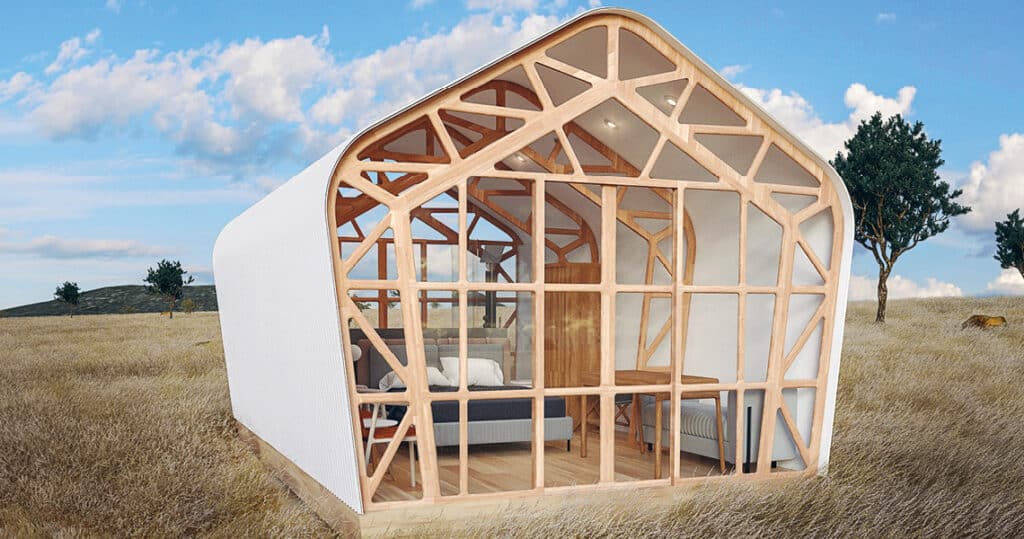
Sitting lightly on the earth was top of mind when David set about designing his Living Pods. The task involved careful planning and conceptualising, in order to create something eco-conscious, mobile and aesthetically pleasing. “Coming from a product design background, I like to think of the pods as large-scale furniture pieces,” David says. “Each piece is made for a specific application to suit its environment, space and requirements. It considers and interacts with its environment.”
David’s lifelong experience with wood and its potential to be sustainable made it an obvious material choice. “To my mind, it’s the best building material in the world,” he says. “I’m interested in the encapsulation of the entire value chain, so we take the timber from seedling to end product. The idea is to use the entire tree, and the associated waste, to keep it as close as possible to the original material.”
As David says, Europeans have perfected this, but it’s not really being done to its full potential in South Africa. “My aim is to change that. In theory, you could create a self-sustaining cycle with limited external input in terms of materials and energy.”
Completely modular, collapsible and lightweight, each Living Pod is easy to assemble, making it the perfect option for remote and secluded locations out in nature. The first Living Pods have been erected at the Kleine Rijke wedding destination in Hartbeespoort. kleinerijke.com
In 2014, design duo Dokter and Misses, along with architect Clara da Cruz Almeida, created a tiny house called the POD-iDladla. This modular, prefabricated nano-home was introduced to a fascinated public at the Nirox Sculpture Park just outside Joburg. podidladla.com
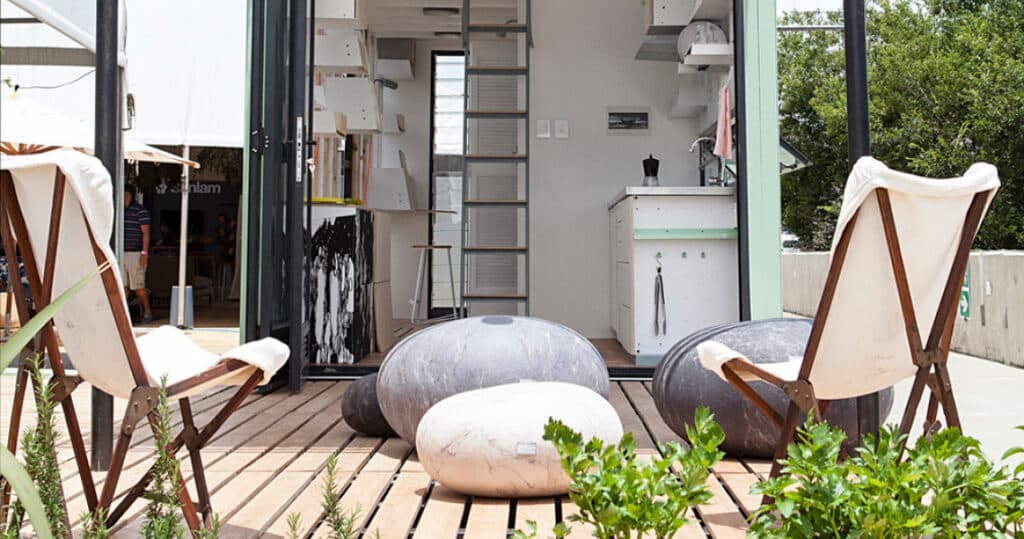
Another local team on a mission to show that tiny home living is for everyone – not only for the nomads – is Matt Bower and Kendal McGlashan, directors and owners of tiny home manufacturing company Wanderlust Co. They offer four variations of mini pods, from the 6.5m x 2.5m J Bay to the roomier 8m x 2.5m Sheffield. “It’s the no-restraints lifestyle that appeals to us,” Kendal says.

THE POD SQUAD
While moving into an 18m2 space might seem simple and blissfully stress-free, downscaling so radically might not be as romantic in the long run. When space is at a premium, there’s no room for frivolous purchases, long lunches with friends or leaving the laundry till later. If you aren’t convinced about living tiny full-time, consider a weekend pod hideaway.


BOTRIVIER
Copia Luxury Eco Cabins offers off-the- grid farm getaways designed around converted shipping containers. Complete with fireplaces, braai areas and wood- fired hot tubs overlooking the Botrivier mountains, these eco-friendly cabins are solar-powered. copiaecocabins.co.za

CAPE TOWN
Tucked into the indigenous greenery of the four-acre private nature reserve at Camps Bay Retreat, you can soak up the sounds of silence in one of the self- contained Village & Life pods built as an alternative to traditional holiday lodgings. At only 18m2, they’re about a quarter of the size of a standard hotel room. The units are completely self- contained; each features a bedroom, kitchenette, shower, toilet and balcony seating area. villagenlife.com
TULBAGH
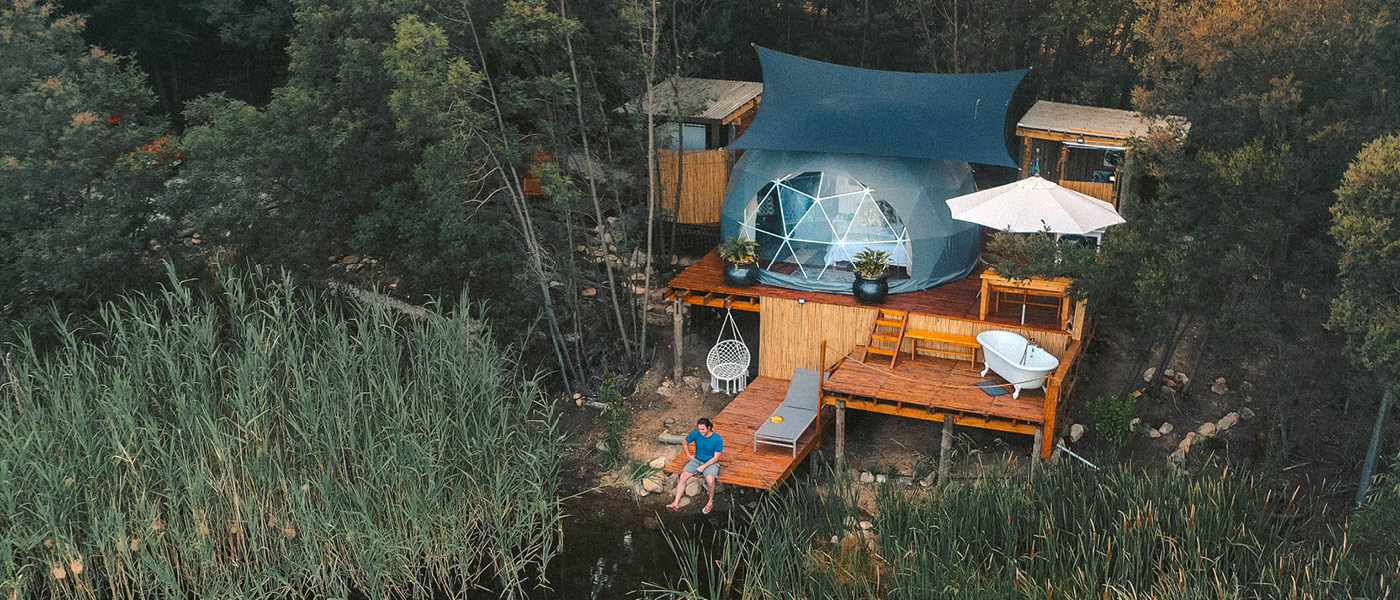
While not strictly a tiny home, the Geodome in Tulbagh offers an understated way of embracing nature without unnecessary frills. Complete with a riverside hot tub, outdoor shower, fully functional kitchen, shaded deck area and simple decor inside a unique dome structure, the Geodome is all about disconnecting in style. Designed by Thor Normann of La Bruyere guest farm, the structure is galvanised steel covered by PVC material. airbnb.co.za


